#agents
Every summary, chronological. Filter by category, tag, or source from the rail.
Lattice Framework, AI Capex Boom, Local Models Rise
Lattice operationalizes AI coding patterns with tiered skills and project context to enforce engineering standards; big tech spends 50-75% of revenues on AI infra while Apple stays at 10% betting on local models; agentic AI risks 'Genie Tarpit' of poor internal code quality.
AI Labs Bet Big on Custom Enterprise Services
Anthropic and OpenAI launch $1.5B+ services JVs to build tailored Claude/GPT agents for businesses, as services emerge as key AI monetization amid agent and inference advances.
AI Agents Blur Vibe Coding into Pro Engineering
Reliable AI coding agents let experienced engineers skip line-by-line reviews for production code, treating them as trusted black boxes—merging 'vibe coding' irresponsibility with 'agentic engineering' rigor, despite normalization of deviance risks.
Codex Edges Out Claude Code as Knowledge Work OS
Austin Tedesco switched to Codex desktop app for 80% of his growth work—automations, GTM plans, KPIs—praising its speed and interface over Claude Code, signaling agent apps as the new OS.
Missions: Three-Role Agents Ship Code for Days
Combine orchestrator (plans with validation contracts), serial workers (implement features), and adversarial validators (verify end-to-end) into missions that autonomously execute software projects for up to 16 days without human attention.
Semantic Primitives Trump Computer Use for AI Agents
AI agents excel at real work by controlling semantic meaning of tasks (e.g., calendar invites, refunds), not just button-clicking access; three layers—access, meaning, authority—define the moat.
Customize VS Code Copilot Agents for Repeatable Workflows
Use VS Code's Customization UI to build custom instructions, agent skills, agents, hooks, and prompt files—define behaviors once for consistent AI outputs across chats, teams, and projects without extensions.
MCP Apps: Interactive Branded UI in AI Chats
MCP Apps let tools return interactive HTML UI chunks over MCP instead of text, enabling branded experiences in ChatGPT, Claude, VS Code; interactions route through hosts to stay in context.
AoE Dashboard Tames Multi-Agent Coding Chaos
Agent of Empires (AoE) orchestrates 5-20+ AI coding agents via a terminal UI dashboard, using git worktrees to prevent branch conflicts and Docker sandboxes for safety, eliminating terminal switching and status guessing.
Knowledge Graphs Fix AI Agents' Memory Goldfish Problem
AI agents fail without persistent memory; replace vector RAG with graph-native systems like BrainAPI to store relationships, enabling reasoning over connected context across sessions.
Remy AI Builds Deployable CRM via Conversation
Remy uses sub-agents for design, architecture, roadmap, and QA to build a full CRM—no code, templates, or manual prompts. Handles spec creation, CSV import, auth, activity feeds, user segmentation, AI summaries, and self-testing before live deployment.
Master Codex: Build YouTube Comment Dashboard Fast
Codex turns ChatGPT into a local agent for building automations, skills, and apps. Follow this project to create a YouTube comment analyzer with Excel insights, web dashboard, weekly runs, and QA—using plan mode, APIs, and deployment.
Agent 365: Govern Sprawling AI Agents Securely
Microsoft Agent 365 acts as a control plane to observe, govern, and secure AI agents across Microsoft tools, local devices, multi-cloud platforms, and SaaS partners, addressing agent sprawl with discovery, policy controls, and runtime blocking—now generally available at $15/user/month.
SAP's $1.16B Tabular AI Lab Bet Blocks Unauthorized Agents
SAP acquires 18-month-old Prior Labs (>$500M cash upfront per sources) and invests €1B over 4 years to build Europe's structured data AI lab using TFMs like TabPFN (3M+ downloads), while prohibiting non-endorsed agents like OpenClaw but allowing Nvidia's NemoClaw.
Modular LLM Agent: Skills, Registry, Dynamic Routing
Build a Python agent system where LLMs dynamically select and chain modular skills via a central registry, enabling composable workflows, hot-loading, and multi-step reasoning.
Secure AI Agents via MCP Toolbox Custom Tools
MCP Toolbox prevents confused deputy attacks by letting developers pre-write constrained SQL tools with bound parameters, separating agent flexibility from app-controlled security for runtime agents.
Anthropic's 10 Finance Agents Accelerate Enterprise AI Adoption
Anthropic ships 10 preconfigured Claude AI agents for finance routines like pitchbooks, compliance, and accounting, deployable as plugins or autonomous workers, with new data partners to win banks ahead of IPO.
Claude's Agentic OS Chains Skills into Full Workflows
Claude becomes an agentic operating system by combining tool use, multi-step planning, and persistent context to orchestrate skills like file access, APIs, and sub-agents, automating business processes end-to-end without manual intervention.
AI Labs Race to Build Enterprise Deployment Layer
OpenAI and Anthropic partner with PE firms and consultancies to deploy AI in enterprises, addressing the adoption bottleneck beyond compute shortages amid explosive cloud growth (Google Cloud +63% to $20B).
Run Gemma 4 Agents On-Device with LiteRT Stack
Gemma 4's 2B/4B edge models enable on-device agents with tool calling, JSON output, and reasoning via LiteRT, delivering low latency, privacy, and cross-platform support on Android/iOS/desktop/IoT.
CopilotKit's AG-UI Enables Dynamic AI Agent UIs in Apps
CopilotKit's open-source AG-UI protocol standardizes AI agent integration with app UIs for interactive components like charts, not just text, with $27M funding to scale enterprise self-hosting.
Claude Managed Agents: Infra-Free Deployment at $0.08/Hour
Anthropic's Claude Managed Agents offloads agent infra, security, and scaling to their cloud for $0.08 per session-hour + tokens, letting you build via API—but vendor lock-in and costs demand ROI checks.
Agents as Tools vs Handoffs: AI Orchestration Trade-offs
Agents as tools centralize control for multi-intent synthesis; handoffs decentralize for phased conversations. Combine both to balance consistency and adaptability in production AI systems.
Consumer AI's Anticipation Gap Blocks True Assistants
Consumer AI agents are reactive tools forcing users to manage prompts and tasks; the frontier is proactive anticipation that notices issues and acts without prompting, but lacks due to messy life data and no 'compiler for taste'.
Claude Code as Second Brain, Video Editor, and More
Use Claude Code's agent system with claude.md files and skills to replace paid tools for second brain management, video creation (Remotion takes 20+ min for 50s clips), grounded research, video analysis, design iteration, content ops, and role-based tasks like finance or teaching—all on free setups.
Build Knowledge Bases from Agent Failures
Assign real enterprise problems to AI agents; their failures reveal exact knowledge gaps. Fill them iteratively to create a demand-driven context base that makes agents semi-autonomous—far better than dumping uncurated RAG data.
RAG Evolves from Keyword Search to Agentic Reasoning
Information retrieval progressed from keyword matching (TF-IDF/BM25) to semantic vectors, hybrid systems, RAG for LLM augmentation, and agentic setups that autonomously plan retrieval, validate sources, and synthesize multi-step answers.
Gemini API Webhooks Replace Polling for Long-Running AI Jobs
Use Gemini API's new event-driven webhooks to get instant push notifications on batch jobs, agent interactions, and video generation completion, cutting latency and API costs from constant GET /operations polling.
Local AI Agent Stack: Ollama as LLM, MCP as Libraries
Build a fully local agentic system treating LLMs as programming languages, MCP servers as libraries, and Markdown skills as programs—orchestrated via Python and JSON config for offline ops queries.
Persist RAG Memory Across Turns with Lakebase PostgresSaver
Swap LangChain's InMemorySaver for PostgresSaver backed by Databricks Lakebase to maintain conversation history in RAG agents, enabling context-aware multi-turn responses like resolving 'it' to prior mentions across Model Serving requests.
Persistent AI Stock Analyst via Karpathy’s LLM Wiki
Give AI agents persistent memory using Karpathy’s LLM Wiki to compound stock insights over time, connecting daily signals into strategic theses instead of stateless summaries.
3 Steps to Custom Claude Code Agentic OS
Codify workflows into domains, tasks, skills, and automations; add Obsidian memory layer; build observability dashboard to track, optimize, and share with teams/clients ahead of 99% of users.
Claude + Higgsfield: Build an AI Creative Agency
Connect Higgsfield CLI to Claude Code to automate market research, brand building, ad/video generation, tracking in Google Sheets, and weekly routines for 100s of marketing assets.
Agents Turn Every Job into a Startup
AI agents unlock an infinite backlog of tasks via 24/7 parallel work, mimicking startup entrepreneurship—exhilarating yet prone to judgment burnout—demanding new roles for coordination, evaluation, and prioritization.
Andrew Wilkinson Runs SaaS & Life via AI Agents
Andrew Wilkinson vibe-codes apps like Deep Personality, runs a $20K/mo SaaS autonomously with Harbor agents for dev/marketing/support, centralizes family office data in vector DBs, and shares prompting tricks—while warning of debugging tax and eroding moats.
Greg Isenberg7 Signs to Switch Browser AI to Desktop Agents
Upgrade from browser ChatGPT/Claude to desktop Claude Cowork/CodeX when handling 10+ files, recurring file updates, self-improving tasks, or scheduled automation—keeps AI intelligence high via folder persistence without long threads.
Top Search/Fetch APIs for AI Agents: Tools & Tradeoffs
TinyFish wins for agent-native search/fetch with free tiers (5 req/min search, 25/min fetch), p50 latency <0.5s, and token-efficient clean markdown/JSON that slashes LLM costs—ideal for production agents.
Sierra's $950M Raise Powers Enterprise AI Agents
Bret Taylor's Sierra raises $950M at $15B+ valuation, serving 40% Fortune 50 with $150M ARR and billions of agent interactions, signaling high upfront costs but massive scale for agentic AI.
Eval-Driven Skills: Boost Agent Performance on Supabase
Use eval-driven development to craft agent skills: define metrics first, structure with progressive disclosure in skill.md, test via Braintrust evals on Supabase workflows, iterate to fix failure modes like unused skills or bad instructions.
Standardize AI Android Coding on Ubuntu with Agent Kit
Install android-agent-project-kit once per repo to enforce shared Android standards across Claude, Codex, and Cursor agents, fixing inconsistencies in architecture, Compose patterns, tests, and PRs for predictable outputs.
Fix Prompt Fragility by Decomposing Agents into Microservices
Monolithic LLM prompts fail unpredictably from tiny changes because one model juggles routing, reasoning, validation, and more—decompose into sub-agents and nano models to shrink context 50-80%, cut costs 60-80%, and eliminate cascades.
Ralph Loops: Repeat Tasks Till AI Ships Perfect Code
Dumb Ralph loops—repeating 'implement ticket' prompts until AI self-corrects—outperform complex agent orchestration, enabling reliable shipping with minimal debugging.
Harness Beats Model: 6x Agent Performance Gap
Stanford/Tsinghua papers prove agent orchestration (harness) causes 6x performance variation on the same model; optimize harness via subtraction and natural language before switching models.
Verifier Agent Crushes AI Coding Review Bottleneck
Stack a verifier agent (GPT-5.5) on your builder (Opus 4.7) to auto-validate outputs via atomic claims, reprompt on failures, and template engineering rules—spending tokens to save review time.
Claude Code Builds Voice Sales Agents in Minutes
Nate Herk demos building a voice agent with Claude Code that captures leads, answers questions, and books Cal.com calls via ElevenLabs—just describe the idea in natural language, no manual dashboard config or docs needed.
AI R&D Automation: 60% Chance by 2028
Benchmarks show AI saturating coding (SWE-Bench: 2%→94%), science reproduction (CORE-Bench: 22%→96%), and engineering tasks, enabling no-human AI R&D by 2028 per public trends.
CLI for Simple Tasks, MCP for Complex Gaps in AI Agents
Use CLI for token-efficient tasks like file ops and Git that models know from training; switch to MCP for abstractions like JS rendering, auth, and governance needs. Agents should choose both dynamically.
Hermes Kanban Enables Durable Multi-Agent Workflows
Hermes v0.11/0.12 shift from chat agents to persistent systems via Kanban boards: local SQLite tasks with dependencies, structured handoffs, retries, blockers, and crash recovery for workflows like feature shipping or PM-engineer-reviewer pipelines.
Symphony: Agents Autonomously Manage Tasks from Linear
OpenAI's Symphony spec lets Codex agents pull open tickets from Linear, work independently until completion, and self-file issues—boosting merged PRs 6x in 3 weeks by eliminating human micromanagement.
LangGraph Builds Resilient Multi-Agent LLM Debate for Drift Tests
LangGraph's stateful graphs, Pydantic schemas, and isolated memory enable adversarial multi-agent debates that run 50 rounds reliably, detecting LLM drift via self-critiquing refinement loops.
DeepSeek V4 + Claude Code Proxy for 76% Cheaper Coding
Use DeepSeek V4 via Anthropic-compatible proxy in Claude Code for basic tasks like scaffolding and unit tests—76% cheaper than Opus 4.7—then switch to premium Claude for complex architecture and UI polish, avoiding rate limits.
Codex /goal Autonomously Shipped 14/18 Features Overnight
OpenAI's Codex /goal CLI implemented 14 of 18 backlog features solo in 18 hours for $4.20 ($0.30/feature), running without human approvals by using soft stops and self-summarization.
5 LLM Agent Patterns for Reliable, Bloat-Free Workflows
Use prompt chaining, routing, parallelization, orchestrator-workers, and evaluator-optimizer patterns to build production-ready LLM agents; start with simple workflows unless tasks demand adaptive reasoning, prioritizing tool interfaces, docs, and logging.
Tiny LLMs and On-Device Agents via LiteRT-LM on Edge Hardware
LiteRT-LM runs Gemma 2B/4B models at 1000+ tokens/sec on phones and delivers agent skills with function calling, while tiny 100-500M param models excel in fine-tuned in-app tasks like voice-to-action at 85-90% reliability.
AI EngineerAgentic Commerce Hands Power to Buyer Agents
Stripe's agent tools let AI carry buyer intent and payment authority directly to sellers, crumbling decades-old seller-controlled funnels and shifting commerce power from stores to buyer agents.
Yin-Yang LLM Pipeline Cuts Noise in Code Scanning
Build reliable AI code scanners by pitting a recall-focused hypothesis agent against a precision-focused evidence agent, stripping reasoning to avoid bias, and enforcing a deterministic policy gate—treating LLMs as stochastic machines, not oracles.
Context Engines: Fix Agent Context to Cut Tokens 50%
Agents fail without org-specific context; build a reasoning layer that personalizes retrieval, resolves conflicts, and respects permissions to deliver task-focused info, reducing task time from 2.5hrs/21M tokens to 25min/10M.
Agentic Pipelines: Cache Keys Cut Token Bloat 95%
Intercept tool calls with a ToolOrchestrator that swaps cache keys for large datasets, keeping LLM context to metadata only—avoids 50k-token ping-pong, slashes latency and costs by 95%, frees model for pure reasoning.
Engineer AI Context Like Code: Full Lifecycle
Treat AI agent context as code with a Context Development Lifecycle—Generate, Evaluate, Distribute, Observe—to create reliable, scalable prompts that drive better agent outputs via testing, sharing, and feedback loops.
Cut AI Agent Costs 70% with Manifest Router
Manifest auto-routes agent LLM calls to the cheapest capable model using 23-dimension scoring in under 2ms, slashing costs 70% without code changes or added latency—self-hosted for privacy.
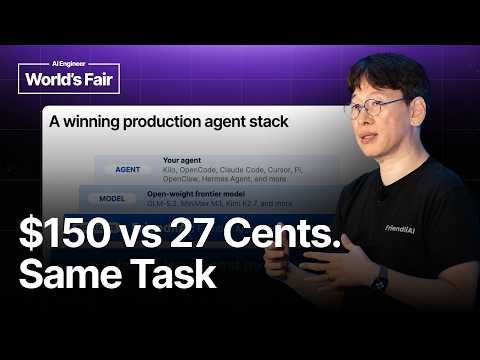
Free NVIDIA NIM API Unlocks Kimi K2.6 for Agentic Coding
Test Moonshot AI's Kimi K2.6 (1T MoE, 32B active params, 256K context, multimodal) for free via NVIDIA's OpenAI-compatible NIM endpoint in tools like Kilo Code—ideal for long-horizon coding agents.
AI Agent Memory: 4 Dimensions, Benchmarks, Tool Tiers
No single tool solves agent memory's four dimensions—storage, curation, retrieval, lifecycle. ECAI benchmarks show full-context approaches hit 100% accuracy but with 9.87s median latency and 14x token costs; selective systems like Mem0 score 91.6% on LoCoMo at <7k tokens/call. Match tiers to stack and bottlenecks like temporal queries.
6 Projects to Go from AI User to Builder in 2026
Build Skills (progressive disclosure folders), RAG (vector search over docs), MCP servers (universal tool adapter), voice agents (Gemini Live), local models (Ollama + Gemma), and fine-tuning (LoRA for behavior) to own AI workflows and stand out at work.
Mistral Vibe Remote Agents Run Coding Tasks in Cloud at 77.6% SWE-Bench
Mistral Vibe now runs coding agents remotely in isolated cloud sandboxes powered by Medium 3.5 (128B model, 77.6% SWE-Bench Verified), enabling parallel long tasks, GitHub PRs, and seamless local-to-cloud teleport without babysitting.
Build Observable Gmail Agents in n8n with Human Controls
Create secure AI workflows in n8n that manage Gmail/Calendar via chat, with built-in observability, granular tool permissions, and human approvals to avoid black-box agents.
AI EngineerIncremental Permissions Unlock Powerful Personal AI Agent
Grant AI agent access one permission at a time—from chat to emails, notes, and OS—to enable ambient overnight ops, attention filtering, task execution, and self-maintenance without breaking your setup.
AI Turns Engineers into Planners and Reviewers
AI coding tools shrink writing time from ~4 hours/day to near zero, shifting effort to planning (saves 30min review per 5min upfront) and reviewing; parallelize agents past 5min executions to maximize throughput.
Multi-Agent AI Pipeline for Systems Biology Analysis
Use Python agents to generate synthetic bio data for gene regulation (14 genes, 0.20 edge prob), predict PPIs (LR AUC/AP on feature diffs/sims), optimize metabolism (8000 flux iters under O2/substrate budgets), simulate signaling (ODE peaks/timings), then GPT-4o-mini synthesizes integrated report.
Claude Code Mastery: 6 Levels to Autonomous Agents
Master Claude Code through 6 progressive levels: from basic installs and prompting to custom skills, sub-agents, parallel teams, and cloud-based autonomous agents running routines while you sleep.
Issue Trackers: Boring Substrate for AI Agents
Legacy issue trackers like Jira provide durable state, ownership, handoffs, and audit trails—exactly what AI agents need for coordination, making them essential infrastructure despite human complaints.
Codex CLI Beats Claude Code on Cost and Autonomy
GPT 5.5 in Codex CLI uses 53% fewer tokens (82k vs 173k), offers smoother UI, better fallbacks, and context-rich subagents, making it more efficient for shipping code than Claude Opus 4.7 despite Claude's UI polish.
Symphony: Orchestrate Coding Agents via Tickets, Not Sessions
OpenAI's Symphony automates coding agents at ticket level using Linear as a state machine; run once, it polls every 30s, spins isolated workspaces, and follows workflow.md for end-to-end task completion without human session management.
Context Engineering Unlocks AI via RAG & GraphRAG
Context—not model intelligence—is AI's main bottleneck. Build contextual systems with connected access, knowledge layers, precision retrieval (agentic RAG, GraphRAG, compression), and runtime governance for relevant, governed outputs.
Codex CLI /goal Auto-Compacts Context, Continues Past Usage Limits
/goal runs autonomous coding agents like Ralph loops; auto-compacts at 100% context (default 258k tokens), blocks auto-approvals at 0% 5-hour usage ($20/mo plan) but finishes prompts.
Parse, Analyze, Visualize Hermes Agent Traces for Fine-Tuning
Extract thoughts/tool calls from Hermes agent dataset with regex parsers; compute stats like avg turns per trajectory, tool frequencies, error rates; visualize patterns; tokenize with assistant-only labels for SFT on Qwen models.
Free Claude Code Proxy: 80-90% Quality at 2-5% Cost
Clone an open-source repo to proxy the Claude Code CLI interface to cheap/free models via OpenRouter, NVIDIA NIM, or Ollama—build full apps like a habit tracker for pennies instead of $5-10 in credits.