Product Strategy
Thinking holistically about what to ship and why. Prioritization, positioning, pricing, and how AI changes what is possible at the product level.
Redefining Startup Org Charts: Delegating to AI Agents
Early-stage founders should shift from asking 'who to hire' to 'what work to delegate,' using AI agents for execution while reserving human roles for judgment, strategy, and culture.
Snap's Pivot: Repositioning $2,200 Smart Glasses as Enterprise Tools
After a disastrous launch, Snap is pivoting its $2,200 Specs from a consumer novelty to an 'AI-native' productivity and enterprise tool, integrating with corporate workflows and anticipatory AI.
Lessons from the AI Graveyard: Why Projects Fail
AI projects fail when they lack product-market fit, are outpaced by platform incumbents, or face critical security and operational hurdles. About 42% of corporate AI initiatives are abandoned due to these challenges.
Optimizing AI Behavior Under Uncertainty with the OUCH Heuristic
Instead of chasing marginal accuracy gains, developers can significantly improve user satisfaction by optimizing system behaviors—acting, stopping, or confirming—based on the relative 'cost' of different error types.
Scaling AI: Moving from Lab Prototypes to Reliable Production
Moving from prototype to production requires shifting focus from 'can it be done' to building the manufacturing, infrastructure, and operational reliability needed for real-world performance.
Building AI Defensibility Against Foundation Model Platforms
To survive as an AI startup, founders must shift focus from model-based features to proprietary data, deep workflow integration, and established customer trust that foundation model providers cannot easily replicate.
Shifting Music from Consumption to Interactive Creation
A Vinyl Bar in Shibuya is building a suite of interactive music apps that prioritize user participation and creative play over passive AI-generated song production.
Measuring AI Agents: The Entropy Matrix and 'Mousepower'
Agents suffer from a measurement problem where token spend is often decoupled from actual value. To succeed, builders must move beyond token-counting to an 'entropy matrix' approach, identifying tasks where verification is cheaper than execution.
 AI Engineer
Practical Scaling Strategies for the AI Era: Disrupt 2026
The Builders Stage at TechCrunch Disrupt 2026 focuses on actionable startup scaling, covering AI-era product strategy, fundraising, talent retention, and the shift toward rapid go-to-market execution.
Digital Sovereignty: Maintaining Control in AI Systems
Digital sovereignty is the ability to maintain control over data, operations, technology, and AI models. Rather than a barrier to innovation, it is an architectural priority that ensures security, trust, and long-term flexibility.
 IBM Technology
European AI Sovereignty and the Question of Control
At TechBBQ, European tech leaders shifted focus from AI capabilities to the urgent need for regional digital sovereignty, debating who ultimately holds power as AI agents become integrated into critical infrastructure.
Building Trust in an Era of AI-Driven Convergence
As AI makes implementation costs approach zero, the competitive advantage shifts from speed to 'signal': the ability to identify unique problems and maintain the integrity of your vision through the build and go-to-market process.
 AI Engineer
OpenAI and Thailand Launch AI Accelerator for Local Startups
OpenAI and Thailand’s Ministry of Higher Education, Science, Research and Innovation (MHESI) have launched an eight-week accelerator to help ten local startups transition from prototypes to production-ready AI products in healthcare and education.
TechCrunch Disrupt 2026: Navigating the New AI Business Reality
TechCrunch Disrupt 2026 focuses on the practical challenges of the AI era, including enterprise deployment, agent security, and the emergence of 'GTM engineering' as a critical new discipline.
How Cursor Built a Category-Defining AI Product
Cursor succeeded by prioritizing a superior user experience over incumbent advantages, betting on a standalone IDE rather than a plugin, and maintaining extreme product focus despite intense competition.
The UX Failure of Exposing AI Architecture to Consumers
AI companies are forcing users to navigate complex, fragmented internal product branding instead of building intuitive, unified interfaces that simply solve problems.
The Rise of Agent Advocacy: Adapting DevRel for AI
Developer Relations is not dead, but its audience has shifted. To remain relevant, companies must optimize for 'Agent-Led' discovery and usage by treating AI agents as first-class users alongside human developers.
Treating Go-To-Market as an AI Engineering Problem
Go-to-market (GTM) is fundamentally a data problem. By building a live model of your market and empowering teams with custom agents and programmatic APIs, you can scale GTM operations with a lean, highly productive team.
Reverse-Engineering the AI Buyer: A Go-to-Market Playbook
Stop building sales teams before you build the machine. Automate your funnel, prioritize self-serve motions to find product-market fit, and reserve human-led sales for high-value enterprise deals.
The AI Startup Cautionary Tale: When Customers Become Competitors
The legal battle between Runlayer and Rippling highlights a critical risk for AI startups: large enterprise customers may use long testing phases to learn your product before cloning it.
Building an AI-Native Health Company: Lessons from Maven Clinic
To become AI-native, shift from long-term planning to 2-4 week sprints, replace delegation with AI-assisted individual execution, and implement tiered reliability standards for non-deterministic AI outputs.
 AI Engineer
Building the Digital Shopping Mall: The Whatnot Strategy
Whatnot is scaling live commerce by prioritizing entertainment and discovery over intent-based shopping, effectively creating a digital mall where users spend 95 minutes a day.
The Rise of the Designer-Founder in the AI Era
AI tools have removed the technical barriers to building, yet designers remain underrepresented as founders. The hosts argue that designers must move past the pursuit of 'ideal' outcomes and embrace the messy, iterative reality of shipping products.
 Dive Club
Gary Tan on Founder Psychology, AI Agency, and First Principles
Gary Tan discusses the evolution of Silicon Valley, the importance of founder earnestness over trend-chasing, and how AI agents are fundamentally changing the speed and scale of building.
 a16z (Andreessen Horowitz)
OpenAI's Strategy for Integrating Ads into ChatGPT
OpenAI is testing non-intrusive, privacy-focused advertising in ChatGPT to fund free access while ensuring ads remain separate from model outputs and user data.
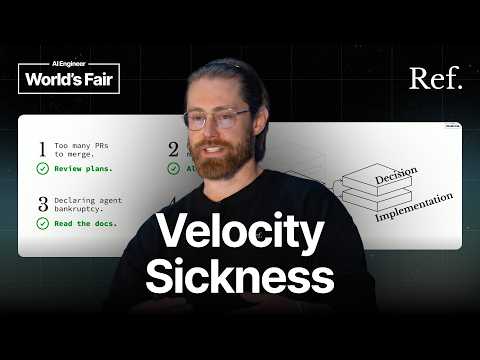
Solving Velocity Sickness: Shifting from Code to Idea Velocity
AI-driven engineering often leads to 'velocity sickness'—high output with low impact. To fix this, teams must shift from chat-based implementation to doc-based decision-making, treating the 'plan' as the primary source of truth and state.
 AI Engineer
TechCrunch Disrupt 2026: AI Infrastructure and Scaling Strategies
TechCrunch Disrupt 2026 (Oct 13–15, San Francisco) focuses on the practical challenges of building, funding, and scaling AI-integrated companies, featuring leaders from Amazon, Replit, Tether, and Rivian.
Build for the Memo, Not the Demo
AI products often fail in high-stakes environments because they prioritize fluency over accuracy. To win, builders must prioritize provenance, transparency in contradictions, and human accountability over model performance.
Scaling Forward Deployed Engineering with Scoping and AI Agents
Forward Deployed Engineering (FDE) requires balancing rigorous manual scoping to avoid 'feature bloat' with the automation of repetitive pipeline tasks using AI agents to maintain competitive velocity.
 AI Engineer
The Evolution and Future of Forward Deployed Engineering
Forward Deployed Engineering (FDE) has evolved from a niche DevOps role into a critical, outcome-oriented discipline. As coding agents make software development cheaper, the core value of the role shifts from writing code to ensuring customer outcomes.
Showing 30 of 73