Software Engineering
Engineering practice, broader than any single framework. Architecture, testing, debugging, and the patterns that survive contact with production.
Automating Python Dependency Resolution with Hybrid Replay-Repair
The paper introduces a hybrid pipeline that combines execution replay and automated repair to resolve complex Python dependency conflicts, significantly reducing manual intervention in environment setup.
Optimizing Transformer Inference with FlashNorm
FlashNorm accelerates transformer inference by folding RMS norm gains into projection weights and parallelizing normalization and matrix multiplication via custom CUDA kernels.
 AI Engineer
Debugging Silent Failures in Stateful LLM Inference
When stateful models like Jamba produce silent errors, they often stem from state cache mismanagement. Debugging requires logprob forensics, threading request IDs through kernels, and identifying how memory pressure triggers hidden architectural flaws.
Optimizing LLM Inference Routing at Scale
OpenAI transitioned from reactive feedback-loop routing to a globally optimized control-plane architecture that balances network latency, engine capacity, and KV cache locality to minimize end-to-end request time.
Homa: Solving AI Networking Latency Bottlenecks
Traditional protocols like TCP and RDMA struggle with modern AI workloads because they treat data as opaque byte streams. Homa, a message-based, receiver-driven protocol, reduces tail latency by over 10x by prioritizing short messages and managing congestion before it occurs.
 AI Engineer
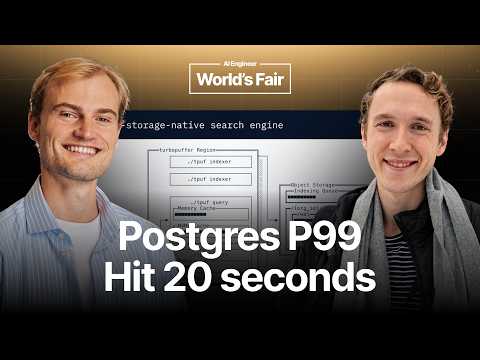
Scaling Legal AI: From Database Thrashing to Object Storage
Legora moved from sharded Postgres to an object-storage-native search architecture (Turbopuffer) to solve cache thrashing, achieve multi-tenant isolation, and support massive legal datasets at a fraction of the cost.
 AI Engineer
Agentic Engineering in Brownfield Codebases
Agents make code changes cheaper, but they don't replace the need for rigorous testing, clear system boundaries, and human-led verification in legacy environments.
Implementing BM25 for Hybrid Search in AlloyDB & Cloud SQL
Google Cloud has added native BM25 support to AlloyDB and Cloud SQL, enabling high-quality, industry-standard full-text ranking directly within the database to improve RAG and hybrid search performance.
5 Principles for Securing AI-Generated Code
AI-assisted development requires moving security from a final checkpoint to a continuous, shift-left process that validates outcomes, dependencies, and agentic intent.
The AI Engineering Skill Stack: From Foundations to Deployment
AI engineering is the practice of building functional systems around existing LLMs. Success requires a three-tier skill stack: technical foundations, AI-specific implementation (RAG/Agents), and production-grade deployment.
 IBM Technology
Scaling Habitat: OpenAI’s Journey from Python Library to Rust Service
To support 1 billion weekly users, OpenAI evolved its 'Habitat' storage platform from a client-side Python library into a centralized service, eventually migrating to Rust to achieve 6x CPU and 15x memory efficiency gains.
Building Ambitious Software in the Age of AI
AI coding agents make code generation cheap, but they do not replace the need for rigorous architecture, manual code review, and human-led testing strategies in complex, long-term software projects.
 AI Engineer
Protecting Your AI Accounts from Session Token Theft
Hackers are using infostealer malware to hijack active Claude session tokens, allowing them to drain user token limits. Anthropic currently lacks granular usage logs, making it difficult for users to detect or audit unauthorized activity.
Shift from Implementation to Decision Quality in the AI Era
AI has commoditized code generation, shifting the engineer's primary value from writing syntax to making high-level architectural decisions, enforcing system-level governance, and validating outcomes through automated testing.
 IBM Technology
The Evolution of Code Review: From Syntax to Outcome Validation
AI is shifting code reviews from manual syntax and consensus checks toward evidence-based validation of business intent, requirements, and outcomes.
 IBM Technology
Optimizing AI ROI Through Trusted Throughput
Stop treating AI token usage as a leaderboard. Instead, optimize for 'trusted throughput'—the volume of high-quality, validated code that successfully clears automated tests, human review, and customer deployment.
 AI Engineer
Building Defensible AI: An Air-Gapped Fortress for Financial Data
To build AI systems that hold up in court, treat them as data pipelines rather than magic boxes, prioritize physical security over software configuration, and use semantic routing to optimize compute.
Formal Verification for AI-Generated Code with Lean4
As AI agents generate code at scale, traditional testing and human review fail to guarantee correctness. Formal verification using Lean4 allows developers to define specifications that machines prove mathematically, ensuring code is correct for every possible input.
 AI Engineer
Scaling AI Agents Safely: A Roadmap for Engineering Teams
Adopt AI agents by prioritizing verification over prompting, treating skeptic feedback as a safety roadmap, and maintaining human-centric communication standards to avoid 'slop'.
From AI-Assisted to AI-Native: Frontier Development Habits
Productivity gains from AI aren't about the tools, but about shifting from 'vibe coding' (babysitting) to 'frontier development' (feeding agents), which requires intentional changes to team habits and codebase hygiene.
Strategies for Serving JAX Models in Production
Moving JAX models from notebooks to production requires choosing the right serialization and compilation strategy to avoid latency spikes caused by just-in-time compilation.
 Google Cloud Tech
Scaling JAX Models to Multi-GPU Systems
Scale JAX models across multiple GPUs by defining array layouts with Mesh and PartitionSpec, allowing the compiler to handle gradient synchronization automatically.
Building and Optimizing JAX Training Loops
Build high-performance JAX training loops by maintaining pure functions, keeping data on-device, and utilizing fused kernels like cuDNN attention to avoid GPU memory bottlenecks.
Scaling Agentic SDLC at Uber
Uber has shifted 70% of pull requests to AI agents by building a standardized infrastructure layer that manages model security, context retrieval, and automated validation, effectively moving the engineering bottleneck from 'how to build' to 'what to build'.
 AI Engineer
Modernizing Legacy Codebases with AI Agents
Tackle legacy code by treating AI as a coworker: use a three-step 'plan, execute, verify' workflow, prioritize test-driven development, and enforce strict guardrails to prevent hallucinations and errors.
 Google Cloud Tech
Architecting Enterprise AI Agents for Regulated Environments
Enterprise AI agents fail in production because compliance requirements are bolted on as an afterthought. Instead, build systems using immutable event logs, segregated object storage, and human-agent parity to make auditability and evaluation inherent to the architecture.
 AI Engineer
Building Resilient Notification Systems with Temporal & Cloud Run
Imaxxing, a viral movie ticket monitoring app, uses Temporal's durable execution and Cloud Run's serverless scaling to handle spiky traffic and unreliable downstream data sources without losing state.
 Google Cloud Tech
The Defender’s Window: Securing Systems in the AI Era
AI-driven cyberattacks are accelerating, but defenders can gain the upper hand by using AI to automate vulnerability discovery, code hardening, and infrastructure remediation at machine speed.
Moving Beyond Line-by-Line Code Reviews with AI
Code reviews are failing because they are bottlenecked and often ignored. Instead of reviewing diffs, teams should review intent and evidence by capturing AI-session decisions, codifying recurring feedback into a registry, and automating verification.
 AI Engineer
Applying RAD Methodology to AI-Driven Development
Rapid Application Development (RAD) provides a proven framework for AI coding: plan lightly, prototype iteratively, and use spec-driven development to bridge the gap between AI-generated prototypes and production-ready software.
Showing 30 of 274